
A penalty kick is awarded if a player commits a direct free kick offence inside their penalty area or off the field as part of play as outlined in Laws 12 and 13.
A goal may be scored directly from a penalty kick.
A penalty kick is awarded if a player commits a direct free kick offence inside their penalty area or off the field as part of play as outlined in Laws 12 and 13.
A goal may be scored directly from a penalty kick.
The ball must be stationary, with part of the ball touching or overhanging the centre of the penalty mark and the goalposts, crossbar and goal net must not be moving.
The player taking the penalty kick must be clearly identified.
The defending goalkeeper must remain on the goal line, facing the kicker, between the goalposts, until the ball is kicked. The goalkeeper must not behave in a way that unfairly distracts the kicker, e.g. delay the taking of the kick or touch the goalposts, crossbar or goal net.
The players other than the kicker and goalkeeper must be:
at least 9.15 m (10 yds) from the penalty mark
behind the penalty mark
inside the field of play
outside the penalty area
After the players have taken positions in accordance with this Law, the referee signals for the penalty kick to be taken.
The player taking the penalty kick must kick the ball forward; backheeling is permitted provided the ball moves forward.
When the ball is kicked, the defending goalkeeper must have at least part of one foot touching, in line with, or behind, the goal line.
The ball is in play when it is kicked and clearly moves.
The kicker must not play the ball again until it has touched another player.
The penalty kick is completed when the ball stops moving, goes out of play or the referee stops play for any offence.
Additional time is allowed for a penalty kick to be taken and completed at the end of each half of the match or extra time. When additional time is allowed, the penalty kick is completed when, after the kick has been taken, the ball stops moving, goes out of play, is played by any player (including the kicker) other than the defending goalkeeper, or the referee stops play for an offence by the kicker or the kicker’s team. If a defending team player (including the goalkeeper) commits an offence and the penalty is missed/saved, the penalty is retaken.
Once the referee has signalled for a penalty kick to be taken, the kick must be taken; if it is not taken, the referee may take disciplinary action before signalling again for the kick to be taken.
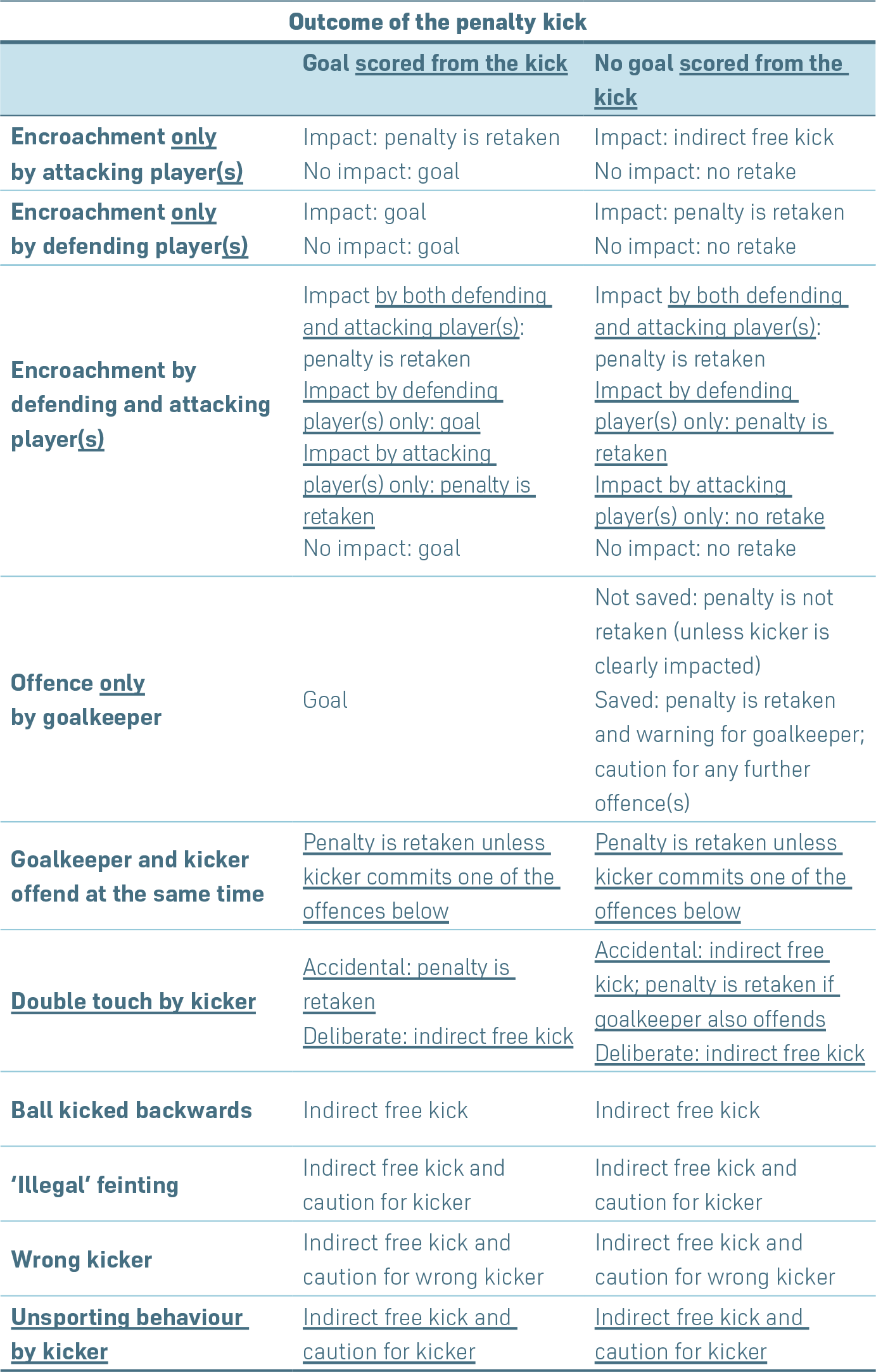
If, before the ball is in play, one of the following occurs:
a team-mate of the player taking the penalty kick is penalised for encroachment only if:
the encroachment clearly impacted on the goalkeeper; or
the encroaching player plays the ball or challenges an opponent for the ball and then scores, attempts to score or creates a goal-scoring opportunity
a team-mate of the goalkeeper is penalised for encroachment only if:
the encroachment clearly impacted on the kicker; or
the encroaching player plays the ball or challenges an opponent for the ball and this prevents the opponents from scoring, attempting to score or creating a goal-scoring opportunity
the player taking the penalty kick or a team-mate offends:
if the ball enters the goal
if the ball does not enter the goal
except for the following when play will be stopped and restarted with an indirect free kick, regardless of whether or not a goal is scored:
a penalty kick is kicked backwards
a team-mate of the identified kicker takes the kick; the referee cautions the player who took the kick
feinting to kick the ball once the kicker has completed the run-up (feinting in the run-up is permitted); the referee cautions the kicker
the goalkeeper offends:
if the ball enters the goal
if the ball misses the goal or rebounds from the crossbar or goalpost(s), the kick is only retaken if the goalkeeper’s offence clearly impacted on the kicker
if the ball is prevented from entering the goal by the goalkeeper, the kick is retaken
If the goalkeeper’s offence results in the kick being retaken, the goalkeeper is warned for the first offence in the game and cautioned for any subsequent offence(s) in the game
a team-mate of the goalkeeper offends:
if the ball enters the goal
if the ball does not enter the goal
a player of both teams offends, the kick is retaken unless a player commits a more serious offence (e.g. 'illegal' feinting)
If, after the penalty kick has been taken:
the kicker
an indirect free kick (or direct free kick for a handball offence) is awarded
the ball is touched by an outside agent as it moves forward:
the kick is retaken unless the ball is going into the goal and the interference does not prevent the goalkeeper or a defending player playing the ball, in which case the goal is awarded if the ball enters the goal (even if contact was made with the ball) unless the interference was by the attacking team.
the ball rebounds into the field of play from the goalkeeper, the crossbar or the goalposts and is then touched by an outside agent:
the referee stops play
play is restarted with a dropped ball at the position where it touched the outside agent
The penalty kick is retaken.
The referee stops play and awards an indirect free kick to the defending team where the second touch occurred unless the referee decides to play advantage.
The kicker is cautioned (yellow card, YC) and play restarts with an indirect free kick to the defending team.
A goal cannot be scored from a penalty kick if the kicker touches the ball again before it has touched another player. However, as the kicker’s second touch was accidental, the penalty kick is retaken.
There is no offside offence, as the ball was not played or touched by a team-mate of the attacker. The referee therefore awards a penalty kick to Team B. The careless challenge itself does not warrant a caution, unless it denied the attacker an obvious goal-scoring opportunity.
Players other than the kicker and the goalkeeper must be outside the penalty area until the ball is in play. Since the line is part of the penalty area and the player’s foot was touching it before the ball was kicked, the team-mate of the kicker encroached and is penalised, as this movement had an impact (the same player scored). The referee disallows the goal and awards an indirect free kick to the defending team where the attacking player entered the penalty area. There is no disciplinary sanction.
The referee awards a penalty kick to Team B. The defender is sent off (red card) for denying a goal by committing a deliberate handball offence. The goalkeeper is cautioned (yellow card) for unsporting behaviour but is not sent off because applying advantage restored the obvious goal-scoring opportunity.
The referee awards a penalty kick. The defender is cautioned (yellow card) if the illegal challenge for the ball denied the attacker an obvious goal-scoring opportunity. Law 16 – The Goal Kick requires opponents to be outside the penalty area until the ball is in play, so the attacker has not committed an offence.
The referee awards a penalty kick. The defender is not cautioned for the SPA offence, as the foul was part of a challenge for the ball punished with the penalty kick, and the careless tackle itself does not warrant a yellow card.
The referee awards a penalty kick for a handball offence because the Team B defender deliberately handled the ball while it was still in play.
The player receiving the dropped ball can dribble or continue playing the ball, with no limit to the number of touches. At the time of the tackle, the ball was in play, so the referee awards a penalty kick. Since the foul was reckless, the defender is cautioned (yellow card) for unsporting behaviour.
The penalty kick is retaken and the defending player is cautioned (yellow card) for unsporting behaviour.
Although player(s) of both teams entered the penalty area early, the penalty kick is not retaken because only the encroachment by the attacker had impact (playing the ball and scoring a goal). Consequently, the referee awards an indirect free kick for the defending team where the attacker entered the penalty area (no disciplinary sanction).
The goal is awarded if there was no clear impact on the goalkeeper. If the encroachment clearly impacted the goalkeeper, the penalty kick is retaken (no disciplinary sanction for the encroaching player).
The referee awards an indirect free kick for the defending team where the attacking team player entered the penalty area. There is no disciplinary sanction.
The referee awards an indirect free kick to the defending team and cautions the kicker (yellow card) for unsporting behaviour. The penalty kick is not retaken because illegal feinting is a more serious offence than illegal encroachment.
The penalty kick is retaken.
The referee awards an indirect free kick for the defending team where the attacking team player entered the penalty area. There is no disciplinary sanction.
The encroachment by the attacking team player is not penalised because it had no impact so the referee awards a corner kick.
The referee disallows the goal and awards an indirect free kick to the defending team where the attacking team player entered the penalty area. There is no disciplinary sanction.
The referee awards an indirect free kick to the defending team and cautions the kicker (yellow card) for unsporting behaviour. The encroachment by the defending player is not penalised because it had no impact.
The penalty kick is retaken only if the encroachment clearly impacted on the kicker or the ball rebounds into play and the encroaching player then plays the ball or challenges an opponent for the ball and prevents the opponents from scoring, attempting to score or creating a goal-scoring opportunity.
The ball position is correct because Law 14 clarifies that part of the ball must either touch or overhang the centre of the penalty mark so the referee allows the penalty kick to be taken.
The referee awards a penalty kick for a handball offence (unnatural position of the hand/arm). The defender is not cautioned (no yellow card) for the SPA offence because the handball offence was not deliberate.
The referee awards a penalty kick for a handball offence (unnatural position of the hand/arm). The defender is cautioned (yellow card) for denying the opposing team a goal but is not sent off (no red card) because the handball offence was not deliberate.
When the referee awards a penalty kick for a handball DOGSO offence, the player is:
cautioned (yellow card) for a non-deliberate handball offence
sent off (red card) for a deliberate handball offence
The referee awards a direct free kick (or penalty kick if the offence occurred inside the defender’s penalty area) and cautions the defender (yellow card). The fact that the reckless tackle occurred after the shot was taken is irrelevant because the ball was still in play at the time of the offence.
The referee awards a direct free kick or penalty kick, depending on where the offence occurred. The offending player is:
sent off (red card) for violent conduct if excessive force or brutality was used; or
cautioned (yellow card) for unsporting behaviour in other cases.
Any deliberate handball by a defending team player inside their penalty area is penalised with a penalty kick. No disciplinary sanction is required as there was no DOGSO nor stopping a promising attack.
The ball was heading towards the goal, so the referee should have applied advantage. However, as the whistle stopped play before the ball entered the goal, a goal cannot be awarded. In this situation, play is restarted with a penalty kick and the defender is cautioned (yellow card) for unsporting behaviour (reckless tackle).
The referee awards an indirect free kick to the defending team because the kicker cannot touch the ball again before it has touched another player. The free kick is taken from the position of the second touch, unless it occurred in the goal area, in which case the free kick may be taken from any point within that area. There is no disciplinary action.
The referee applies advantage for the offence committed outside the area and awards a penalty kick for the pulling in the penalty area. The defender is sent off (red card) for DOGSO, as the offence was neither an attempt to play nor a challenge for the ball.
The penalty kick is retaken and the goalkeeper is warned if it is their first offence.
If the nearest point to the offence on the boundary line is:
within the defender’s penalty area, a penalty kick is awarded
outside the penalty area, a direct free kick is awarded
Regardless of the restart decision, the defender receives the appropriate disciplinary sanction:
a caution (yellow card) for unsporting behaviour, or
a sending-off (red card) for violent conduct
The referee awards a penalty kick. The defender is cautioned (yellow card) for SPA because their offence was not an attempt to play the ball or a challenge for the ball.
The referee awards a direct free kick or a penalty kick if the offence was committed within the offender’s penalty area. The offending player is sent off (red card, RC) wherever the offence occurred.
The referee awards a penalty kick. The player is cautioned (yellow card, YC) because the offence was an attempt to play the ball.
The goalkeeper is cautioned (yellow card) for unsporting behaviour (showing a lack of respect for the game/opponent) or for delaying the restart of play.
The referee awards a penalty kick. The player is cautioned (yellow card) for unsporting behaviour and not sent off because the DOGSO offence was a challenge for the ball.
The referee awards a penalty kick and sends off (red card) the defender because their DOGSO offence was neither an attempt to play the ball nor a challenge for the ball.
The referee awards a penalty kick because the defender re-entered the field without the required permission and interfered with play inside their penalty area. Law 12 states that if this offence denies the opposing team a goal, the player is sent off (direct red card).
Yes, provided that the 'new' player taking the penalty kick is clearly identified.
According to Law 1 – The Field of Play, the lines belong to the areas of which they are boundaries so the foul is considered as having occurred inside the penalty area. The referee awards a penalty kick and cautions the defender (yellow card).
The referee awards a penalty kick because there is no offside offence if a player receives the ball directly from a throw-in.
The referee should wait a few seconds to allow a possible advantage to develop. However, as play has been stopped by the referee, the ball was out of play when the goal was scored so it cannot be awarded. In this case, play is restarted with a penalty kick for the handball offence and, depending on the exact situation, any appropriate disciplinary action.
The referee awards a penalty kick. The defender is not cautioned (no yellow card) because the offence which stopped a promising attack occurred inside the defender’s penalty area and was a challenge for the ball.
The referee awards a penalty kick and sends off the defender (red card for a DOGSO offence). The referee cannot apply the advantage and award the goal because the player scored in the opponents’ goal immediately after the ball had touched their hand/arm.
The referee awards a penalty kick. The defender is sent off (red card) for DOGSO because the offence was not an attempt to play the ball or a challenge for the ball.
The referee awards a penalty kick and cautions (yellow card, YC) the defender for the reckless challenge. There is no YC for the SPA offence because, by playing the advantage, the promising attack was continued/restored.
The referee awards an indirect free kick to the defending team because the kicker played the ball a second time before it has touched another player.
The referee plays the advantage for the goalkeeper’s offence and awards the goal. As the penalty kick is not retaken, there is no disciplinary sanction (warning or caution) for the goalkeeper.
As long as the player is inside the field of play, outside the penalty area and behind the penalty mark, the goal is awarded.
The goal is awarded. Law 14 does not require that the kicker must take a shot. Passing the ball is allowed provided that the ball is not kicked backwards and the kicker does not touch it a second time (before it has touched another player).
The referee awards a penalty kick and sends off the defender. When two offences occur at the same time, the more serious offence must be punished. Therefore, it is a red card for serious foul play (not a yellow card for the DOGSO offence that was a challenge for the ball inside the penalty area).
The goalkeeper is allowed to move their body and arms provided their actions/gestures are not judged by the referee as being disrespectful and/or unfair.
The referee disallows the goal (because of the offside offence) and awards a penalty kick (as the holding offence occurred before the offside offence). If the foul denied an obvious-goal scoring opportunity (DOGSO), the defender is sent off (red card, no attempt to play the ball or challenge for the ball). If it was not a DOGSO situation, the defender is cautioned (yellow card).
The amended Law 14 requires the defending goalkeeper to have at least part of one foot touching, in line with, or behind, the goal line until the moment the ball is kicked. Therefore, the goalkeeper has not committed an offence and the referee allows play to continue.
The referee awards a penalty kick and takes appropriate disciplinary action against the goalkeeper:
caution (yellow card) – if the offence was reckless or denied the opponent an obvious goal-scoring opportunity
sending-off (red card) – if the goalkeeper endangered the safety of the attacker
The referee applies advantage for the push and awards a penalty kick for the tripping offence which occurred inside the penalty area. If the tripping offence stopped a promising attack or denied the attacker an obvious goal-scoring opportunity, the defender receives the appropriate disciplinary sanction.
If the first offence was by the defender in their penalty area and the ball was in play, it is a penalty kick – it does not matter where the ball was when the offence occurred as long as it was in play. The defender is sent off (red card) for violent conduct.
Play restarts with a goal kick unless the goalkeeper’s offence clearly impacted on the kicker. In this case, the kick is retaken; the goalkeeper is warned for the first such offence in the game and cautioned (yellow card, YC) for any subsequent offence(s) in the game (including the re-take).
The referee allows play to continue unless the goalkeeper’s offence clearly impacted on the kicker. In this case, the kick is retaken; the goalkeeper is warned for the first such offence in the game and cautioned (yellow card, YC) for any subsequent offence(s) in the game (including the re-take).
The penalty kick is retaken. The goalkeeper is warned for the first offence in the game and cautioned (yellow card, YC) for any subsequent offence(s) in the game (including the re-take).
The referee stops play and awards a penalty kick to Team A. The goalkeeper is sent off (red card) for violent conduct. Before the penalty kick is taken, Team B must either:
decide which of the remaining players on the field of play will become a new goalkeeper and change their equipment accordingly
substitute one of the remaining players with a substitute goalkeeper (if they have not already used the maximum number of permitted substitutes)
The referee disallows the goal and awards an indirect free kick to the defending team where the player feinted to kick the ball. The player is shown a second yellow card (for unsporting behaviour), then a red card and is sent off.
The referee awards the goal provided that the kicker or his/her team-mate(s) has not committed any offence. The match ends once the goal is scored so the final whistle should be blown – there is no kick-off.
The referee awards a penalty kick. The defending team player is sent off (red card).
An indirect free kick is awarded to the defending team. The kicker is cautioned (yellow card, YC) for unsporting behaviour.
Play is stopped by the referee and restarted with an indirect free kick to the defending team, regardless of whether or not a goal is scored. The player who took the kick is cautioned (yellow card).
The kicker may only touch the ball again after it has touched another player otherwise it is an indirect free kick to the defending team (or direct free kick for deliberate handball).
The player is cautioned (yellow card, YC) for unsporting behaviour and the penalty kick is retaken. A free kick cannot be awarded against the offender because the ball was never in play.
In both cases the ball remains in play and assuming there have been no offences committed:
If the ball rebounds from the goalkeeper, the kicker can play the ball again and score a goal.
If the ball rebounds from the crossbar/goalposts, the kicker must not play the ball again until it has touched another player.
Yes, provided that the 'new' player taking the penalty kick is clearly identified.


